

This page may contain one or more affiliate links, which means that if you purchase a product through that link, I may receive compensation. The links will be identified with the text "affiliate link". Click to learn more.
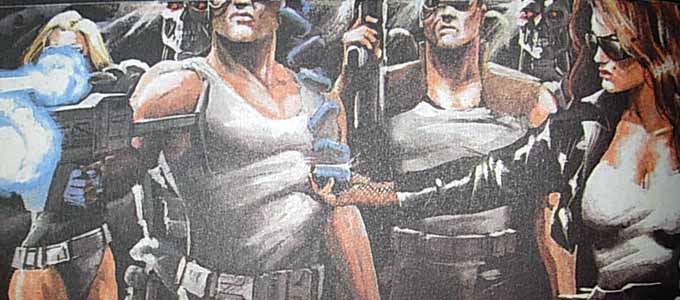
Curious about the first Alex Ross art done in comic books? I do not blame you. Alex Ross has been called the Norman Rockwell of comics, due to his realism and strong use of photo reference. His first published work for comic books was in a short series for Now comics called Terminator: the Burning Earth.
Terminator: The Burning Earth tells the story how the Skynet (the system running the Terminators, the killing machines that have overtaken the planet) was finally stopped by cutting off their power source. A strategy not very dramatic but more plausible than most alternatives. The story is spread across five intriguing story lapses that have been made beautiful with the Alex Ross art that has accompanied it.
Before I had seen any Alex Ross art in my life, or even knew who the heck Alex Ross was, I came across the first Terminator Burning Earth comic book at a flea market. I thought the cover looked cool, so I bought it. Years later, I was flipping through the price guide in the back of Wizard Magazine, and I was stunned to see the comic I bought dirt cheap being displayed as significant. That was the first time Alex Ross’ art had made any impact on me, and I was not even aware that it had happened.
What is interesting about these comics is how the terminators look. Some have a sort of light visor thing, and others look human. There are also many that look like women, which is an unusual characteristic of a terminator.
As an extraordinarily talented comic artist, Alex Ross has quickly become a seminal figure within the industry. With his lifelike illustrations and authentic storytelling, he redefines the artistic boundaries that have long shaped the world of comic art. Ross’s attention to detail and his ability to infuse emotion into each scene has captured the hearts of both casual readers and dedicated comic enthusiasts alike. By exploring the depth and breadth of his work, we gain a greater appreciation for the indelible mark he’s left on the entertainment landscape.
If you are a graphic novel kind of person and can’t be bothered to hunt down all five issues, you can buy Terminator: The Burning Earth
Terminator Comic Books
If you have ever wondered how many Terminator comic books exist, the answer is that there are actually a pretty surprising number of them. The franchise has been bouncing around the comic industry since the late 80s, long before anyone thought the movies would become a permanent part of pop culture. The first big run came from Now Comics, the same publisher that released Terminator: The Burning Earth. They published a series simply called The Terminator that ran for 17 issues and focused on the future war, with resistance fighters trying to survive Skynet’s endless waves of machines. It was very much the kind of comic that leaned into the bleakness of the future, with lots of ruined cities, lots of laser fire, and tons of metal skeletons doing what metal skeletons do.
After Now Comics folded, Dark Horse Comics took over and basically became the main home for Terminator stories for many years. Dark Horse published a whole line of miniseries that expanded the mythology in ways the movies never had time for. Titles like Tempest, Secondary Objectives, The Enemy Within, Hunters and Killers, and Endgame all explored different missions involving Terminators, resistance fighters, and time travel. Dark Horse also went pretty wild with crossovers. RoboCop versus The Terminator is probably the most famous one, and it is exactly the kind of comic you think it is. They also published Superman versus The Terminator: Death to the Future, which is one of those things you sorta forget exists until someone reminds you. And yes, there really was an Aliens versus Predator versus The Terminator comic, which is basically the sci fi equivalent of dumping every action figure on the floor and saying okey dokey, let’s see what happens.
Other publishers have taken a swing at the franchise too. Marvel Comics released the official comic adaptation of Terminator 2: Judgment Day in 1991, which followed the movie closely. Malibu Comics published Terminator 2: Cybernetic Dawn, which continued the story after the film, alongside Terminator 2: Nuclear Twilight, which explored the prequel era of the future war. Later on, IDW Publishing and Dark Horse produced various comics tied to Terminator Salvation, with Dark Horse ultimately releasing Terminator Salvation: The Final Battle to fill in gaps around John Connor’s war against Skynet. So if you get into Terminator: The Burning Earth and want more of that kind of future war junk, there are actually loads of Terminator comics out there, covering everything from straight resistance stories to pretty wild crossovers that make the franchise feel much bigger than the movies ever showed.
The Appeal of Alex Ross
The art by Ross is realistic. The style of comic books, which is always exaggerated and also excessive, is not what you find in Ross’ illustrations. He brings the lifelike image into his creations by making sure that everything he draws is a true reflection of reality. This even includes paying attention to small things like cloth texture and facial wrinkles on a character’s face. It’s more than just visual appeal; it’s about adding depth and grounding those characters in an actual living world through their environment and everything else that’s around them.
One more thing that is captivating about his art is its color usage. His paintings are rich and vibrant, which sets them apart from other comic book art. In his works, he employs a wide range of techniques, including watercolor and gouache, to produce an impression of texture and depth. This gives a new level of dimension to his art that is missed in most conventional comic book images.
Certainly, one of the most beautiful aspects of the art is the feeling that he puts into his characters. His drawings are not only visually attractive but also narrative. So many emotions can be read from an expression on the face of one of his characters because it is richly detailed and subtle, allowing it to express satisfaction, disappointment, or even enthusiasm or courage. Being able to show the character in this way is what definitely distinguishes Ross’s artistic works from others and makes them so impressive at the same time.
Having knowledge not only in his field of expertise, but also having respect for comic book heroes’ history and folklore, is an additional strength of Ross. Very often he makes allusions to the legends, thus showing that he is well familiar with the entire background of this art form. All this further enhances a sense of nostalgia and affinity with the audience, which are all helpful elements when trying to appeal to die-hard comic book aficionados.
His art’s popularity and prestige shouldn’t be surprising. The mystic fusion of realism, color, passion, and homage to originals in the source materials characterizes him as the most desired comic book artist in this field. His paintings were also recognized not only in the comic world but also in galleries and museums globally, thus naming him a genuine master of his occupation.