

This page may contain one or more affiliate links, which means that if you purchase a product through that link, I may receive compensation. The links will be identified with the text "affiliate link". Click to learn more.
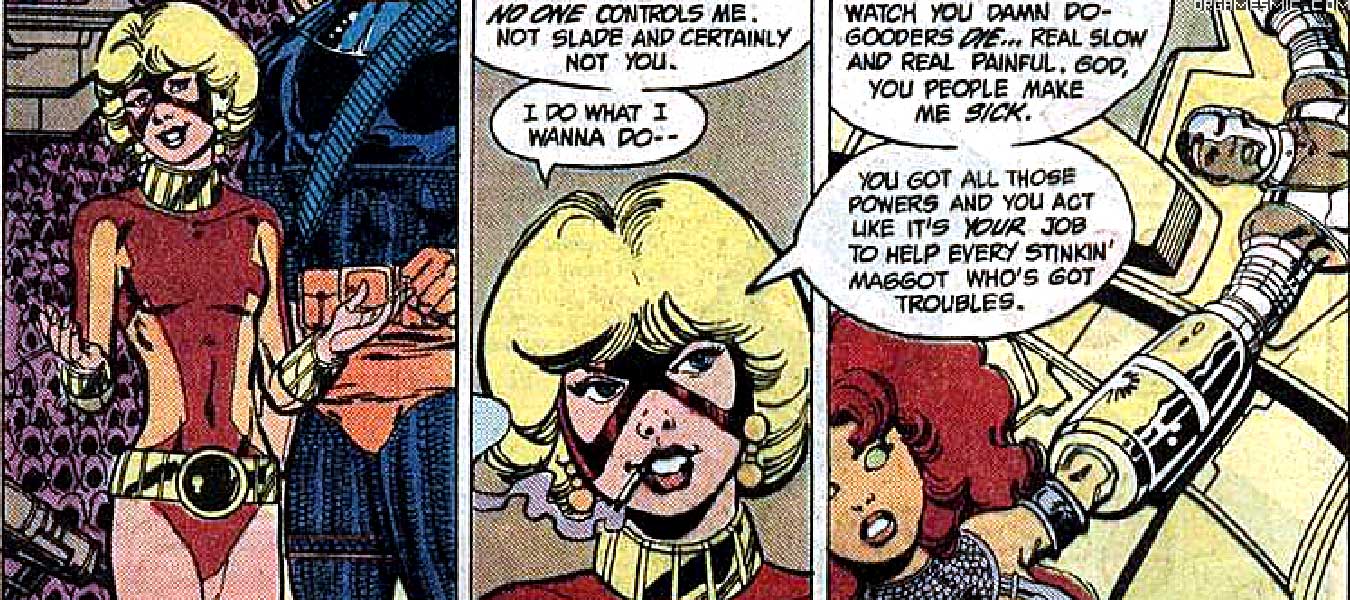
“The Judas Contract” stands out as one of the most popular and memorable storylines from The New Teen Titans comic books. It has been adapted multiple times into animation, showing its influence and impact. The memorable story began in Tales of the Teen Titans #42-44 and the third annual in 1984, where we not only do we get a closer look at a chaotic character named Terra, but also the complete origin and background story of Deathstroke. The infinitely loved character Nightwing also appears for the first time in this storyline, as Dick Grayson evolves past his identity as Robin and begins disassociating himself with Batman.
The comic story was so popular that it was adapted twice into animation. The first time was for the second season of the Teen Titans television series in 2004, and the other was for an animated movie that was more bluntly titled Teen Titans: The Judas Contract. In both adaptations, the character Terra has an altered appearance, probably due to her original outfit in the comics revealing her legs a bit too much.
Comic Book Foundation
Before we can even begin to break down the variations seen in the animated movie, we have to look back at the original comic book story. The story arc technically kicks off in New Teen Titans #34 (volume 1), but the bulk of the story really unfolds in Tales of the Teen Titans #42 (affiliate link) as opposed to the team’s main ongoing series.
Side note: New Teen Titans during the ’80s was DC Comics’ top‑selling title (source). Alternate titles like Tales of the Teen Titans usually pop up when a series gets big enough to branch out and cash in on its popularity. (And titles aimed at teens are apparently the easiest to market, since they’ve got disposable income from mom and pop and don’t need their milk money anyway.)
The details of the story involve Terra, who had become a member of The Teen Titans with open arms, is actually a spy for the villain Deathstroke. A contact lens camera that makes it easy for her to show Deathstroke (aka Slade Wilson) all of their secrets. This is best explained in New TT 39 when we see Terra showing him images of them on a giant screen. She is sitting on a bed wearing merely a robe and smoking a cigarette, implying that she and Slade were lovers. (Tales of TT Annual 3 confirms this.) Slade understands though that Terra is an unstable sociopath filled with hate. She manipulates each team member and kisses Changeling (Garfield Logan) because he admitted to her that he likes her.
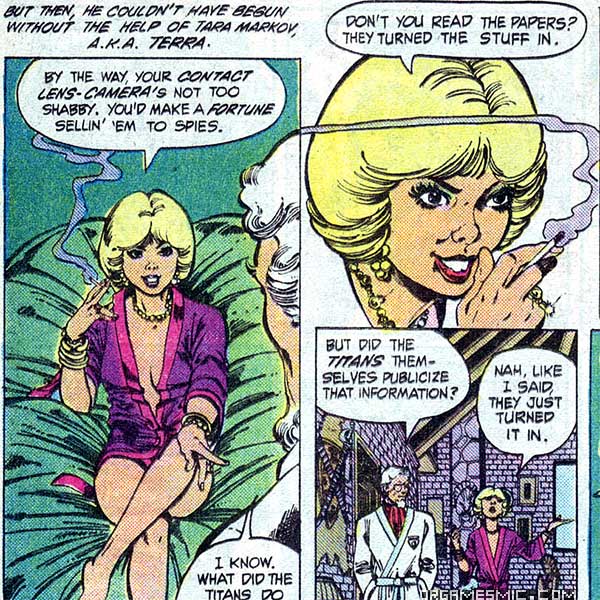
After taking pictures of the homes and hangouts of all the Titan members, Terra now knows all of their secret identities and locations. Using this information, Deathstroke easily sets up traps to capture them, except for Raven, who is captured with the assistance of Terra, and Robin (Dick Grayson), who was able to outsmart Deathstroke. Grayson was underestimated. Slade crashed into his apartment window, not expecting him to slip out the window and disappear into a crowd. Despite being injured, he discovered that all the other Titans had been previously captured.
The situation, actually, was rather comical. Slade was confident that Grayson couldn’t evade capture when, in fact, he took advantage of a blow to bounce himself out a window. I guess being an ex-trapeze artist pays off when you’re up against an experimentally enhanced super-soldier.
At this point, Robin finds some unexpected help from Deathstroke’s wife Rose and her son Jericho. We discover the backstory of Slade Wilson, who was a top military soldier with advanced training provided by his future wife. As if that were not enough, Slade is involved in an experimental procedure that has increased his brain capacity by 90% and improved his reflexes, strength, and speed beyond what a typical human could do. We also find out that Slade’s son was captured at some point and had a knife held to his throat. Despite Slade rescuing him, he was not quick enough, and Jericho permanently lost his ability to speak.
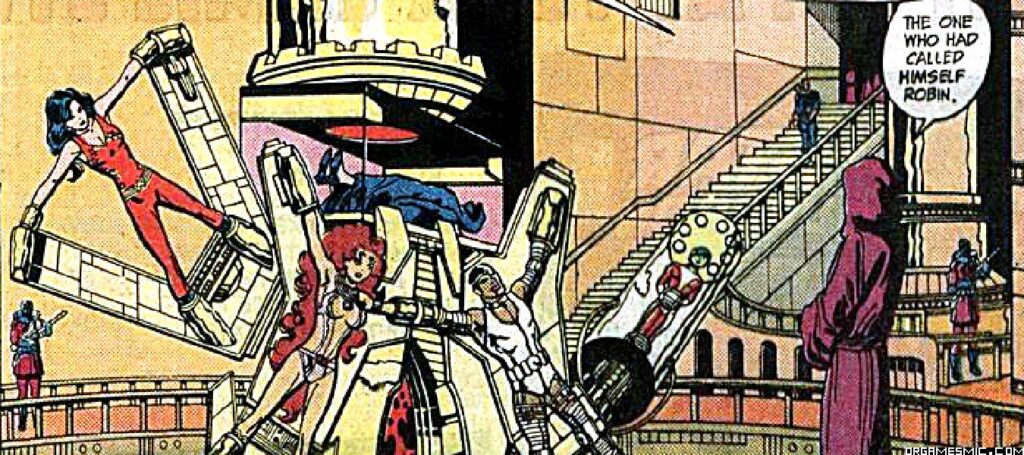
In the final comic of the story arc, Tales of TT Annual 3, we discover that The Hive were the one that actually wanted the Teen Titans captured, and Deathstroke inherited the contract from one of his dead sons. In this same issue, we also learn a lot about Terra and the intricacies of the plot. Apparently, Terra is the one that approached Deathstroke, and since they slept together, she may have been manipulating him from the start. We also get confirmation that Terra had just turned 16 (and her birthday was celebrated in New TT 34), which means that she was not even old enough to drive (in the US) at the time she was intimate with Slade. The story ends with Terra’s pure hatred causing her to accidentally kill herself in a rubble of rocks and dirt. (How convenient that The Titans didn’t have to kill their former team member!)
The Judas Contract Animated Movie
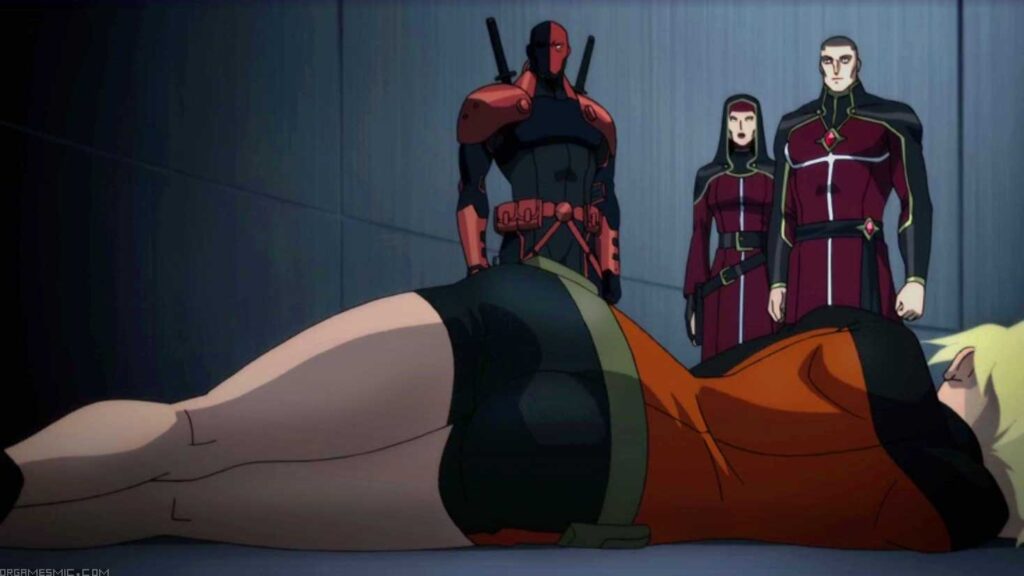
The animated movie, which goes by the blunt title “Teen Titans: The Judas Contract” has the same basic framework as its comic book origins but has significant changes that change the context of the story. While the comic version has Deathstroke recognizing that Terra is an uncontrollable sociopath, the animated movie has him telling her what she wants to hear and manipulating her into thinking that they will be together as a couple.
The animated film has Terra’s motivation be her lust for Deathstroke, rather than her intending to kill the Teen Titans because of their condescending ways. In the comic, we saw Terra in a revealing robe to imply that she just slept with Slade. The movie version though, in contrast, we see her in a seductive robe because she is trying to convince him to sleep with her. In this same scene, Terra makes it clear that she is not a child and that she is older than she looks. This change in age was probably to remove the awkward age difference between the two characters that was present in the comic.
Among the major differences in The Judas Contract animated movie version compared to the original comic source is the absence of Slade’s son Jericho as well as a detailed account of his origin and backstory. This affects the ending, as Jericho is never captured, but rather Terra is betrayed by Deathstroke when The Hive needs one more superpowered being to power their machine. We also see Deathstroke receiving a large amount of money, changing his reasons for assisting The Hive to simply receiving dolla dolla bills y’all.
Terra’s Character Traits
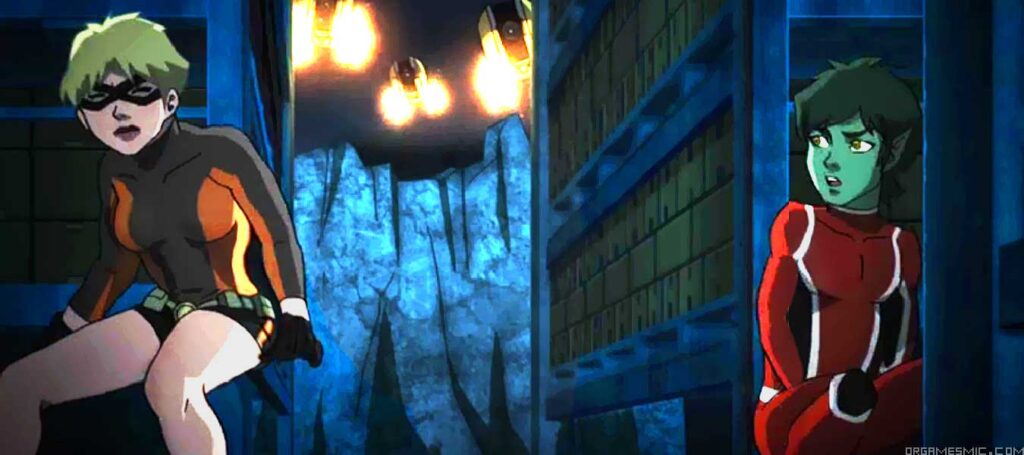
We should probably talk about Terra’s compression shorts, or “booty shorts” in this case since they emphasize her butt area. I suppose they provide her with slightly more modesty compared to the high-cut legless outfit she wore in the comics. But in reality, these skintight short-shorts arguably draw more attention to her lower region than before. They still provide the awkward contrast of her upper garment being long-sleeved and full coverage, while the lower half remains mostly exposed. (It’s no wonder Changeling was enticed by her so much.)
Terra’s bubbly and cute demeanor, along with her bob cut and bucktooth appearance, are gone in the animated movie. Now she’s all business, initially turning away Garfield’s advances by ignoring him (what some people would say women do well in real life) and just generally being an introverted jerk. This makes the Judas-style betrayal less shocking and hurtful to the watcher compared to the comic reader caught by surprise.
In Closing
The Judas Contract remains one of the most influential Teen Titans stories ever published, and every adaptation reflects a different era of DC storytelling. The original comic leans into psychological manipulation, betrayal, and the darker edges of the Titans’ world, while the animated movie streamlines the plot for modern audiences and reframes Terra’s motivations. Whether you prefer the classic Marv Wolfman and George Pérez version or the animated reinterpretation, The Judas Contract continues to shape how fans understand Terra, Deathstroke, and the Teen Titans as a whole. Its legacy endures because it blends character drama, shocking twists, and the kind of emotional stakes that defined the Titans throughout the 1980s.